This section brings together all selected writings on contemporary art, exhibition practices, and Indigenous representation. The texts are also organized thematically and can be accessed through the menu under the following sections: “Accessibility”, “Art Exhibitions”, “My Art and Curation”, “Conciliation”, “Cultural Appropriation”, “Indigenous Art, Display, and Criticism”, and “Other Writing”.
Most Canadians and Americans believe they live in post-colonial countries, independent since 1867 and 1776, respectively. However, First Nations, Inuit, Métis, and American Indians living in these same territories remain under imperial control. Their lands are occupied, not by Britain, but by Canada and the United States. There is a growing drive to decolonize art exhibitions, museums, universities, and most everything else. If these efforts are predicated on ideas and practices from states where imperialists have actually left, they must be re-tooled to be meaningful in places where settlers have no such plans.
Settler Decolonialism and Indigenous Non-colonialism in the Visual Arts
The final report of Canada’s Truth and Reconciliation Commission begins: “For over a century, the central goals of Canada’s Aboriginal policy were to eliminate Aboriginal governments; ignore Aboriginal rights; terminate the Treaties; and, through a process of assimilation, cause Aboriginal peoples to cease to exist as distinct legal, social, cultural, religious, and racial entities in Canada.” The rest is footnotes—sober, thorough, harrowing, insightful, and moving descriptions of the mechanisms and effects of the slow, relentless genocide machine.
Indigenous Creative Sovereignty after Canada’s Truth and Reconciliation
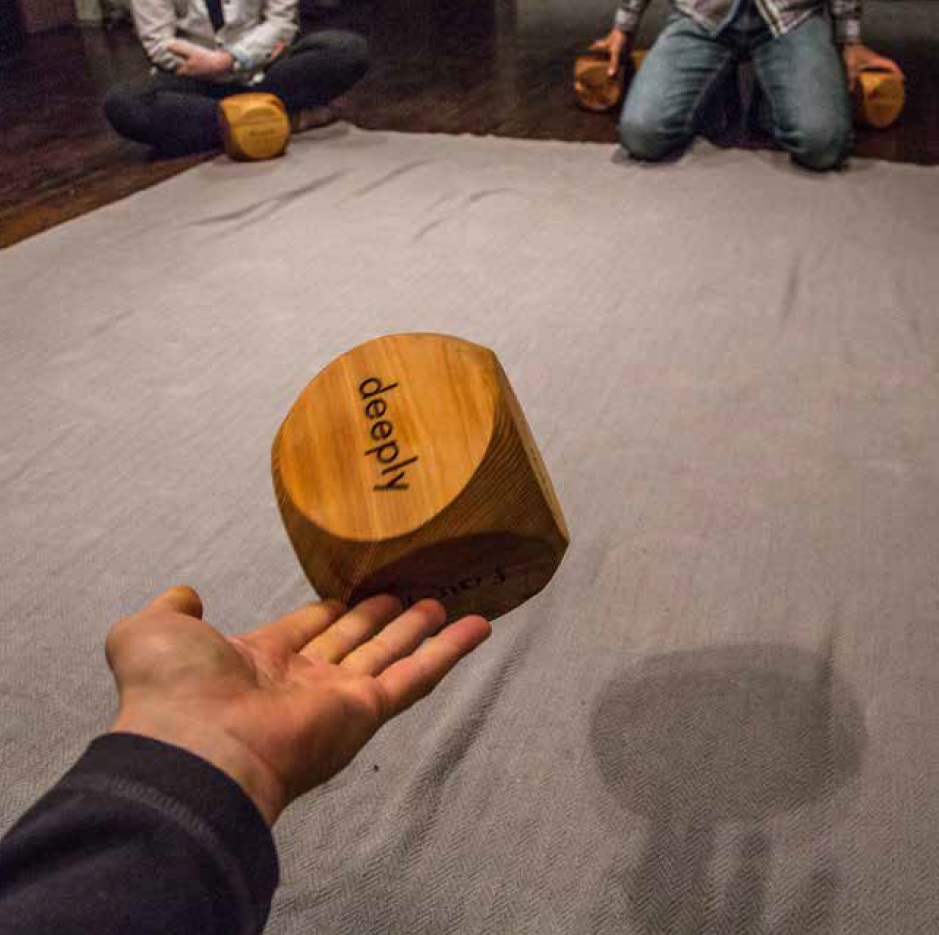
Snow and rain. Escaping the slushy, wet darkness, seven people gather in a circle around a generic grey blanket. In the centre are several oversized cedar dice incised with words. The first reads “I am,” “you are,” “we are,” and “they are.”
The second reads “fairly,” “deeply,” “very,” “so,” “not,” and “somewhat.” The final die has five sides reading “sorry,” and one with “tired of this” carved into it. The possibilities and combinations disassemble and reassemble as everyone reaches for the dice to smell and feel their heft, their smooth rounded sides.
APOLOGY DICE: COLLABORATION IN PROGRESS