DAVID GARNEAU

Indigenous Art, Display, and Criticism

This section brings together all selected writings on contemporary art, exhibition practices, and Indigenous representation. The texts are also organized thematically and can be accessed through the menu under the following sections: “Accessibility”, “Art Exhibitions”, “My Art and Curation”, “Conciliation”, “Cultural Appropriation”, “Indigenous Art, Display, and Criticism”, and “Other Writing”.

Unnatural Natives: Beyond Indigenous Idealism and Fundamentalism

Unnatural Natives: Beyond Indigenous Idealism and Fundamentalism

Native people and their land are interconnected. We have all heard this. The very definitions of the words ‘Native’ and ‘Indigenous’ bind bodies to specific places. Every First Nation, Inuit, and Métis Elder, Knowledge Carrier, and academic that I have read, listened to, and talked with about this subject not only agree, but recognize this as an essential truth. Leanne Betasamosake Simpson and Glen Coultard, for example, describe this web of reciprocal relations associated with a specific place as grounded normativity.

Transits and Returns

Transits and Returns

Hello, Kimberley. I have an enduring memory of our first day in Norway last November 30. You, a tall Yorta Yorta woman delicate on the icy sidewalks of Kirkenes. Your usually confident stride minced by the threat of a slip. Métis from Amiskwaciy, Northern Turtle Island, now known as Edmonton, Canada, and now living in Oscana, Pile of Bone, Regina, I am more accustomed to winter. I felt compassion but had no remedy. Your uncertain steps caused me to reconsider conditions I take for granted.

Representing “Indians”: H. G. Gylde’s Rutherford Library Mural as Seen by a Métis Artist

Representing “Indians”: H. G. Gylde’s Rutherford Library Mural as Seen by a Métis Artist

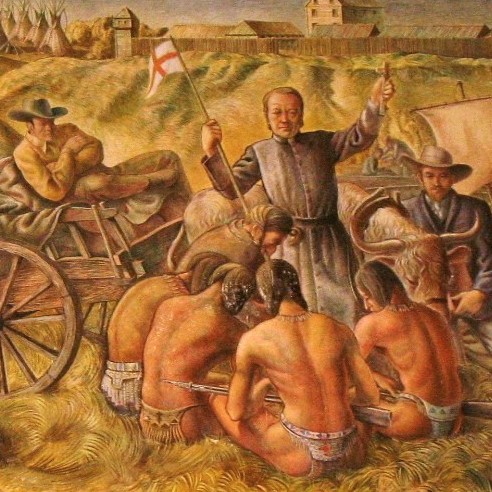
Henry George Glyde’s sixty-year-old mural, “Alberta History,” has been getting some attention recently—critical, but revitalizing nevertheless. Art lives only through the attentions of the quick, and these hungry ghosts are not fussy about whether the notice is positive or negative.

Non-colonial Indigenous Art Gallery and Museum Displays

Non-colonial Indigenous Art Gallery and Museum Displays

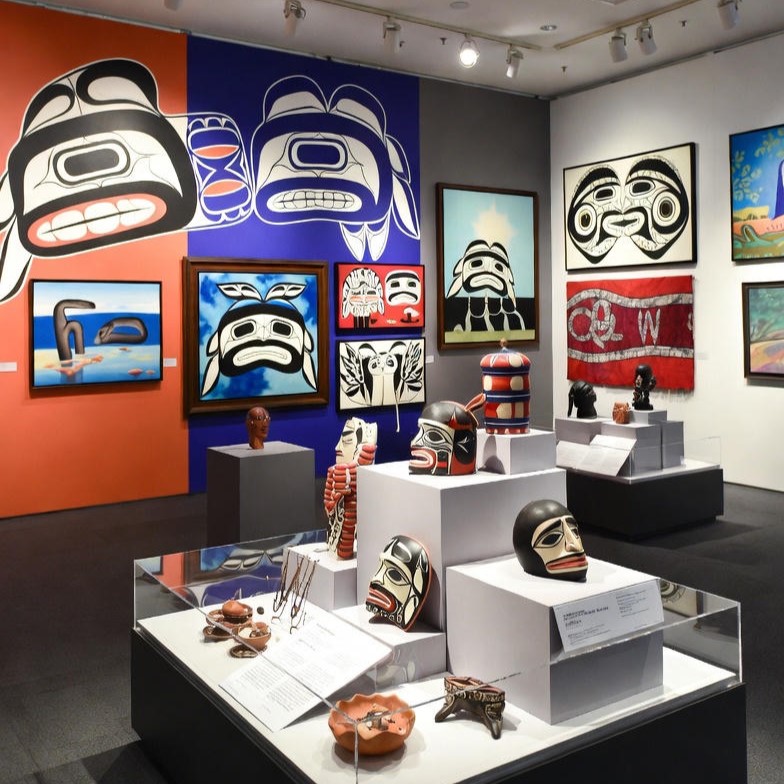
Art galleries and museums were never public institutions in the sense of “standing outside of the state and functioning as a means of criticizing it,” explains Tony Bennett. They were and are state organs designed to produce meanings that serve the needs of the nation and those citizens who most benefit from it. They perpetuate national ideology especially in the middle and professional classes who engage cultural institutions to learn what is expected of them. These publics go to absorb the cultural competencies necessary to reinforce and secure their social status and distinguish themselves from the working class.

Necessary Essentialism and Contemporary Aboriginal Art

Necessary Essentialism and Contemporary Aboriginal Art

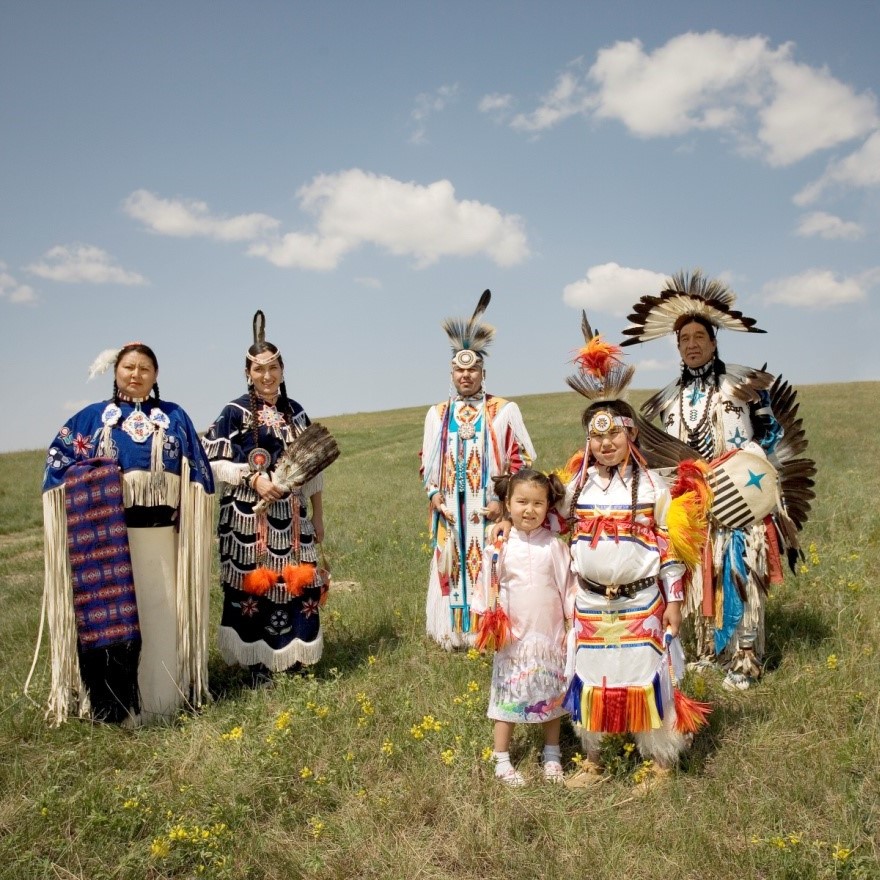
This photograph, by Terrance Houle, shows six people standing in full regalia on a hill of semi-arid short grass on a beautiful summer day. Saying ‘regalia’ rather than ‘Indian costume’, indicates a minimum level of cultural sensitivity, but not as much awareness as if I deduced their tribal affiliation from the beading designs. To do so would to be to read the picture as intended.

Migration as Territory: Performing Domain with a Non-colonial Aesthetic Attitude

Migration as Territory: Performing Domain with a Non-colonial Aesthetic Attitude

De-, anti-, and post-colonial academic writing tend to concentrate on the political aspects of Indigenous being. While necessary work, prerequisite for our survival, without the counterbalance of critical creativity, the visions produced in this mode are incomplete, limiting, and aesthetically conservative. The centring of governance and power in Indigenous academic thinking is a totalizing project. It applies simplified abstract principles to complex real beings and things. It endeavours to fix and manage, understand and control.

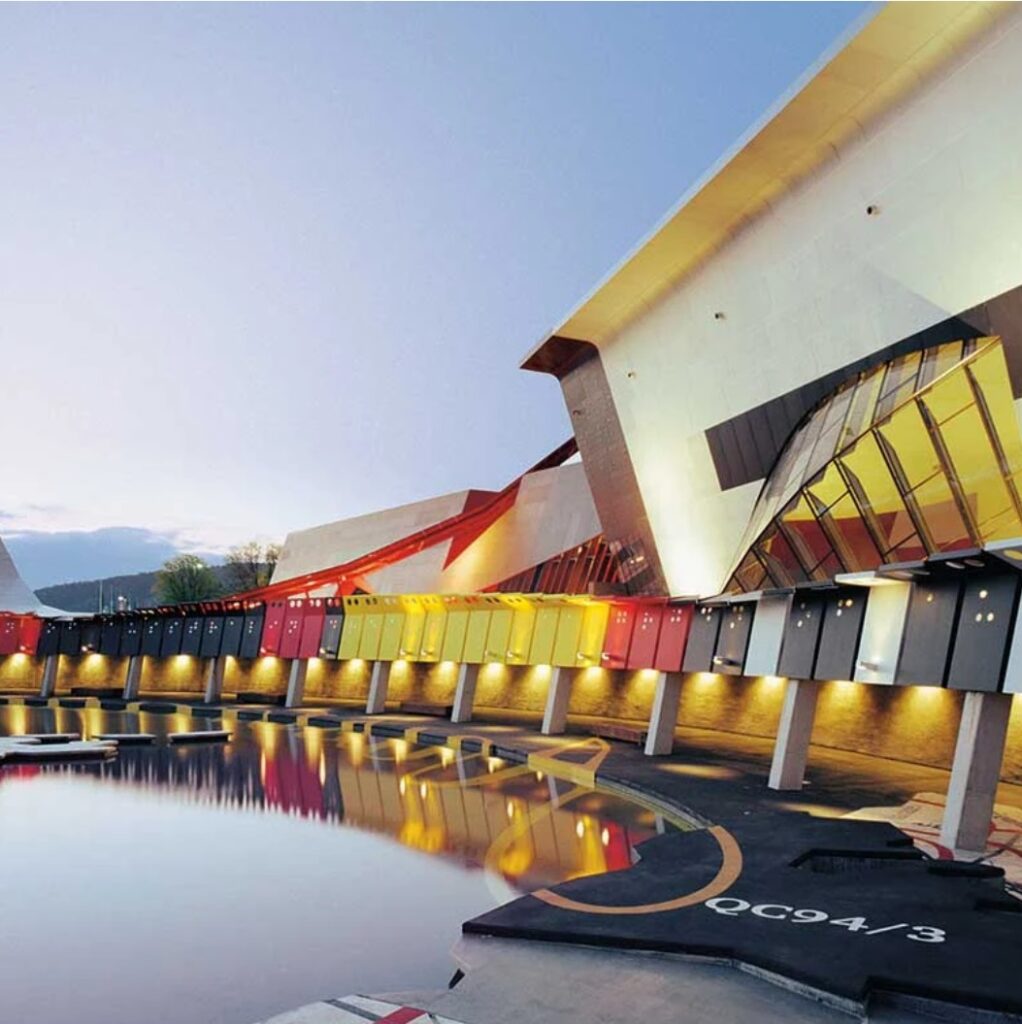
From Indian to Indigenous:Temporary Pavilion to Sovereign Display Territories

From Indian to Indigenous:Temporary Pavilion to Sovereign Display Territories

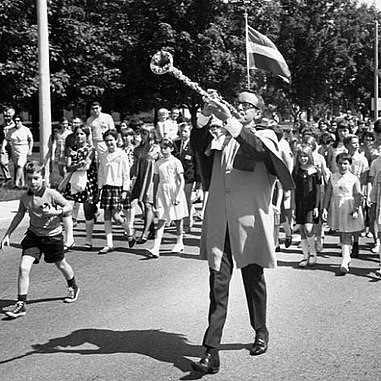
Expo 67: I was five years old, conscious of the hoopla, but we lived far from Montreal and could not afford the fare. The World’s Fair came to the Prairies mostly in black and white, on television and in the newspaper. The coincidental Canadian Centennial celebrations were more accessible. On Dominion Day eve, the ‘pied piper of Canada’ arrived in Edmonton. Bobby Gimby was a middle-aged white man who played a faux jewelled trumpet and wore a cape.

Extra-Rational Aesthetic Action and Cultural Decolonization

Extra-Rational Aesthetic Action and Cultural Decolonization

For several years I have been disturbed by memories generated by three artistic actions: a yell by Rebecca Belmore as a prelude to a panel discussion; Guillermo Gómez-Peña’s threat to decapitate a woman during a work of performance art; and Terence Houle’s naked, fleshy belly in photographs and performances. Most days the images, sounds, thoughts, sensations and feelings engendered by these scenes course through my mind and body as a prickly trickle undisturbed by analysis. Other times, I slow the flow and attempt to discover why they stick around, what they want.

From Artifact Necropolis to Living Rooms: Indigenous and at Home in Non-colonial Museums (excerpts)

From Artifact Necropolis to Living Rooms: Indigenous and at Home in Non-colonial Museums (excerpts)

Replying to a colleague who was defending a friend, Winston Churchill famously quipped, ‘He is a humble man, but then he has much to be humble about!’ I resemble that remark. I am neither a museum curator nor anthropologist, not a PhD of any strain. I curate art, mostly Indigenous, in Treaty Four and Six territories. I am an artist who teaches painting and drawing at a regional university in Canada, Saskatchewan, Regina—the very trifecta of modesty. Ironically, in the inverted worlds of the contemporary museum and academy, where margins often centre, having much to be humble about can be a quality.

Electric Beads: On Indigenous Digital Formalism

Electric Beads: On Indigenous Digital Formalism

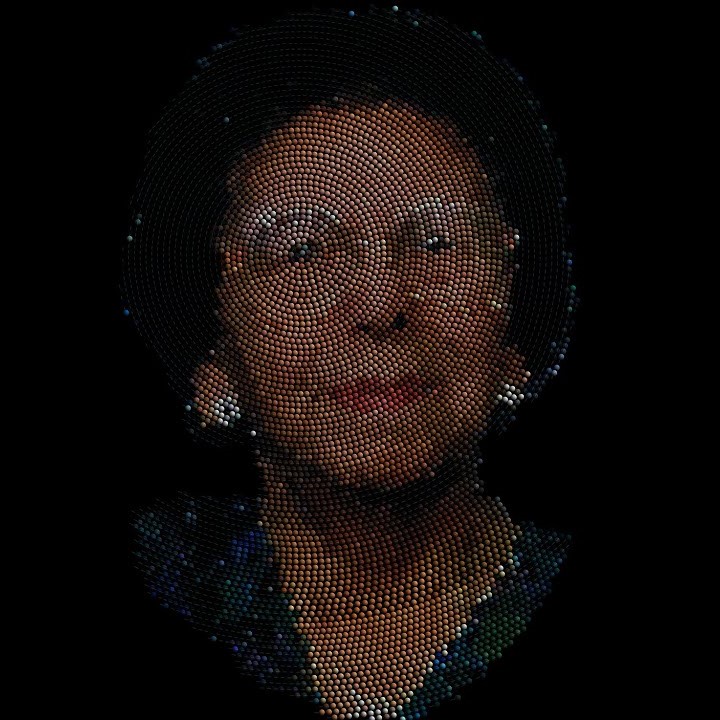
It begins as a small point of light in a dark room. A second glowing square quickly materializes, then a third, and in rhythmic succession at the rate of four a second a chain of thousands coils around the first and forms a spiral. Early on you wonder if the pixel colours are arbitrary or intend to picture. It takes several dozen silent beats of light before what might be a face emerges. Then yes, it is a face, a mature woman, she smiles.

“Contemporary Métis Art: Prophetic Obligation and the Individual Talent”

“Contemporary Métis Art: Prophetic Obligation and the Individual Talent”

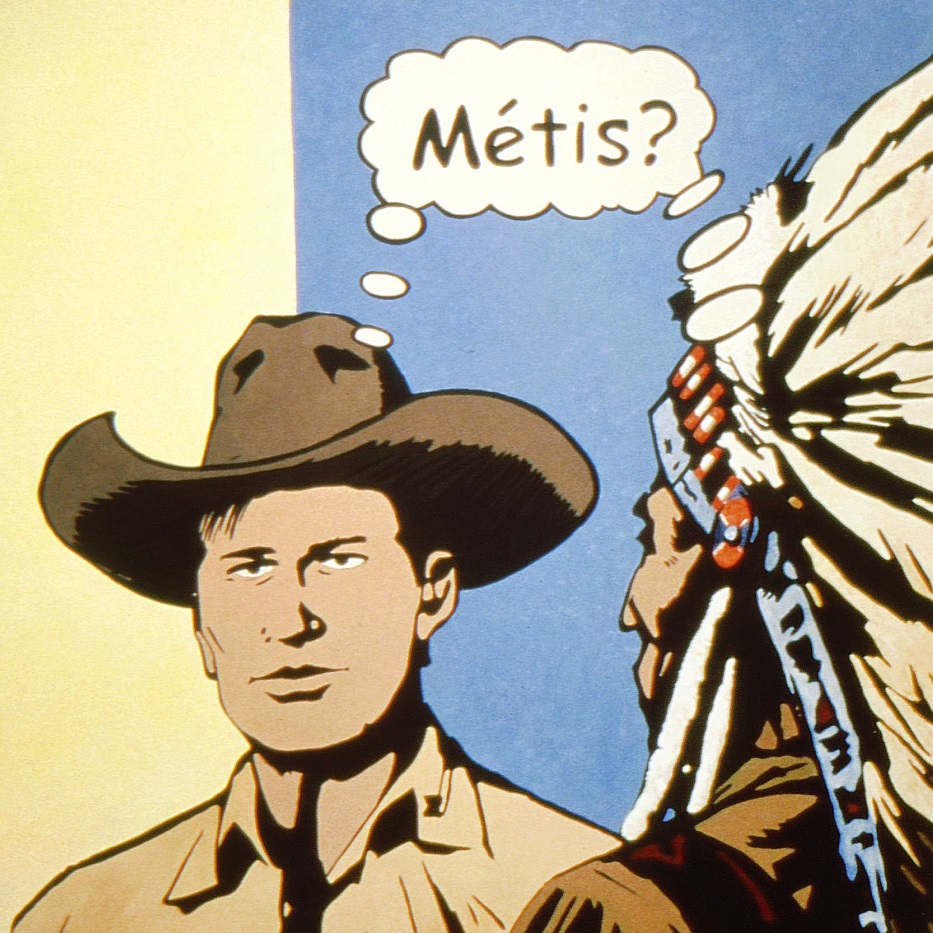
“Cross Addressing” (2002) is a painting of two men: one dressed as a cowboy, the other in comic-book-Sioux regalia. They share a common question and thought balloon: “Métis?” If both are, the image presents Métisness as an expanded field, one that includes seeming-cowboys and might-be-Indians. The picture also suggests that Métis appearance is not always easy to read, even for Métis. If either man is of mixed blood, they may be looking for signs of kinship to melt the ice.

From Colonial Trophy Case to Non-Colonial Keeping House

From Colonial Trophy Case to Non-Colonial Keeping House

My father, Richard Garneau, loved science and local history. He took us, his five kids, to museums, planetariums, and historic sites throughout Alberta and British Columbia. When I was 10 (1972), we found a very unusual object newly installed in the Royal Alberta Museum (Edmonton): a smooth but dimpled slab of brown iron that seemed neither quite human-made nor natural.

Can I Get a Witness? Indigenous, Art, Criticism

Can I Get a Witness? Indigenous, Art, Criticism

“Indigenous” is an emerging identity that extends and adapts First Peoples’ ways of knowing and being to the contemporary moment and to spaces beyond our home territories. Natives from around the world – enabled by advancements in communication, transportation, government policies, and funding, and driven by a sense of urgency arising from degradations to our persons, our sovereignty, and our environments – are connecting with each other to produce inter-National networks and a collective consciousness. Art is part of this movement.

Indigenous Criticism: On Not Walking with Our Sisters

Indigenous Criticism: On Not Walking with Our Sisters

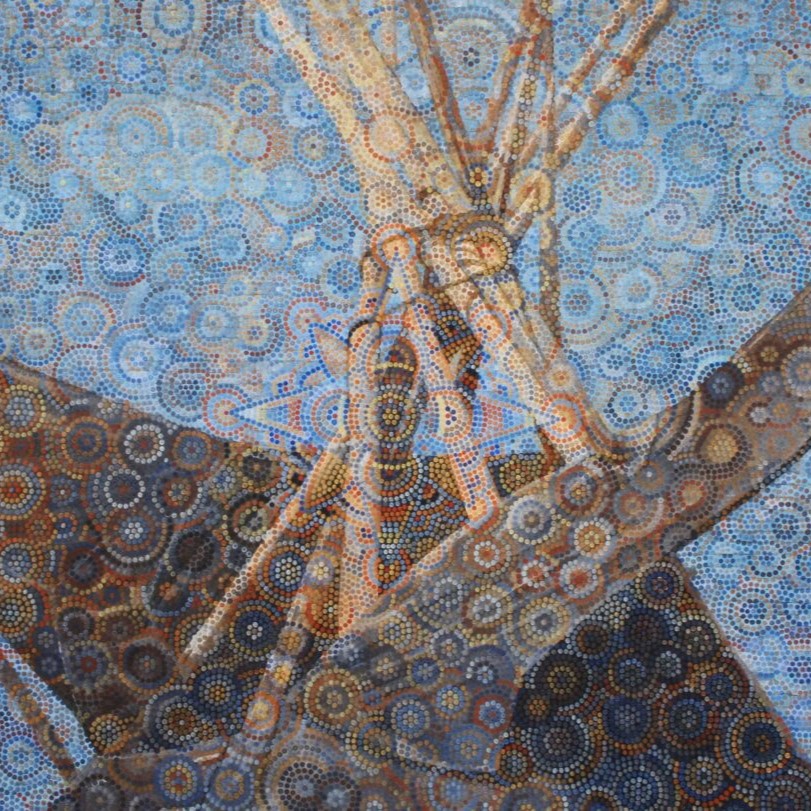
Last November 24th, in Saskatoon, celebrated artist Rebecca Belmore (Anishinaabe) declined to enter the Walking with Our Sisters exhibition of beaded moccasin vamps memorializing murdered and missing Indigenous women. Two days earlier, in Calgary, curator and critical art writer Richard W. Hill (Cree) challenged the use of clichéd and dubious signifiers of Indigenity such as “dream catchers; four sacred colour designs, and some of the teachings around that; and phrases such as ‘Turtle Island’, ‘Mother Earth’, ‘Great Spirit’; and the use of sweat lodges and tipis by people and in places not historically associated with those things.”

An Uncertain Latitude

An Uncertain Latitude

I wonder about artistic privilege. The advantages, attention, and public money granted to select artists, but especially the social margin, passage, and exception we occasionally enjoy. In exchange, artists make the absent present. We reflect the fleeting known in condensed, beautiful, novel, and more permanent or replicable forms. We recite, repeat, refresh, and invent. Artists fabulate the real. We devise the displays by which a people know and show themselves. We entertain. We educate without looking you in the eye.

Non-Colonial Indigenous Public Art and Memorials

Non-Colonial Indigenous Public Art and Memorials

Following final reports from The Truth and Reconciliation Commission of Canada (2015) and the National Inquiry into Missing and Murdered Indigenous Women and Girls (2019), and ongoing revelations of unmarked graves at former Indian Residential School sites, Canada blooms with Indigenous memorials and public art. Too often, however, these works, and the committees that select them, reproduce colonial habits. They present Aboriginal appearance rather than embody Indigenous engagement. Methodologies to assist folks develop Indigenous public art as a form of conciliation exist.

Restor(y)ing Colonial Public Art

Restor(y)ing Colonial Public Art

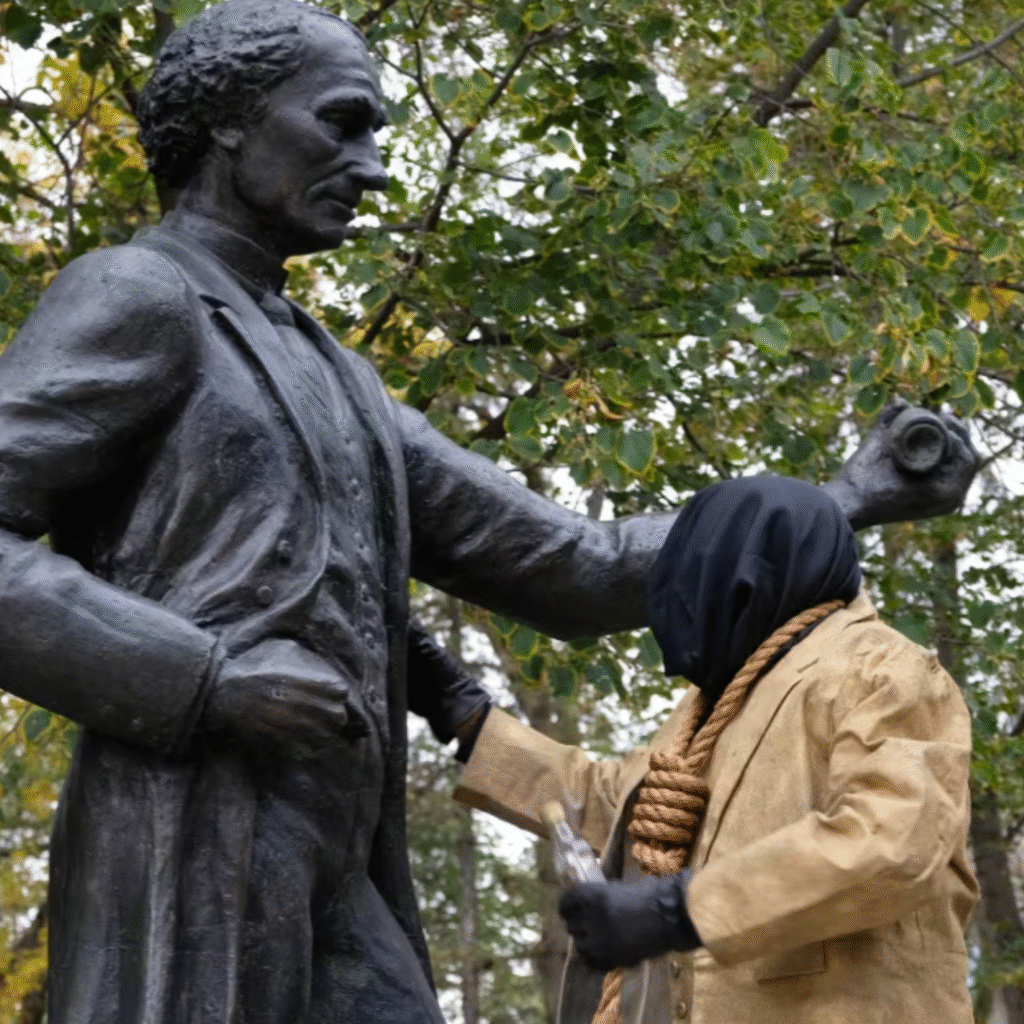
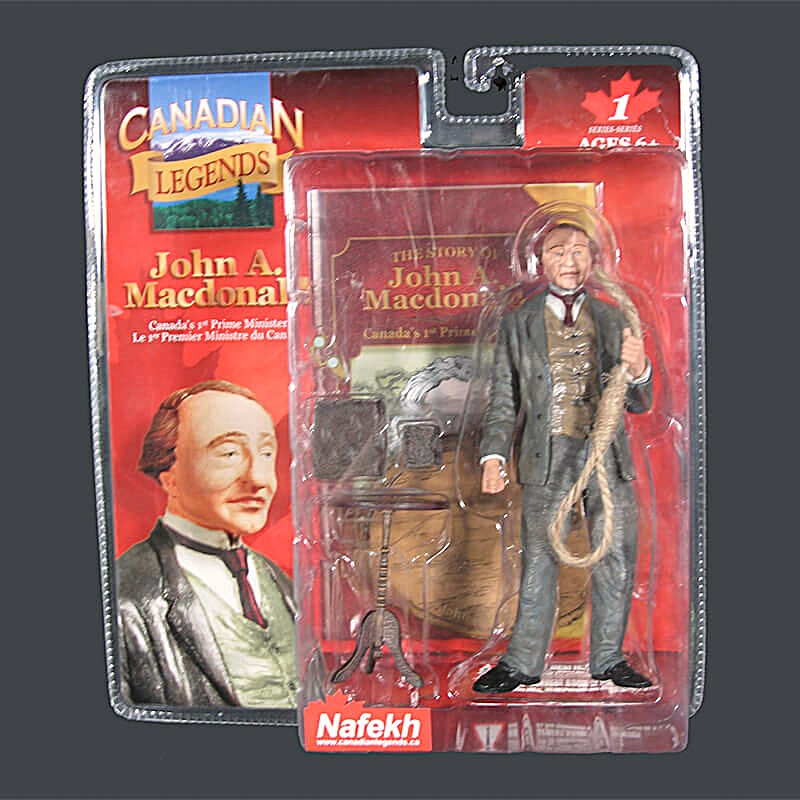
A few years ago, as a work of performance art, I dressed as Louis Riel and visited statues of John A. Macdonald. While I wished these metal effigies gone, I did not dream it would happen. I appreciate their later removal in Regina and Kingston as a sign of post-TRC progress. That said, should all public art deemed sexist, racist, and/or colonial propaganda be purged?

Reason for Passion

Reason for Passion

I am conflicted about the recent vandalism and destruction of colonial statues and churches in Northern Turtle Island. As a visual artist and writer who tries to make meaningful and well-made things, and who appreciates how difficult and fragile art and consciousness are, I distrust the direct, the rapid, and the destructive. Born with a preference for reason over passion, I am compelled to collect and evaluate the facts before judging, before acting. The problem with reason, however, is that it can be too reasonable. Slow, cool calculations oil the machinery of the status quo and discourage passionate action—any disruptive action, really—beyond opining or art making. And, at times like ours, both reason and art fail to satisfy the need for radical change.

Writing About Indigenous Art with Critical Care

Writing About Indigenous Art with Critical Care

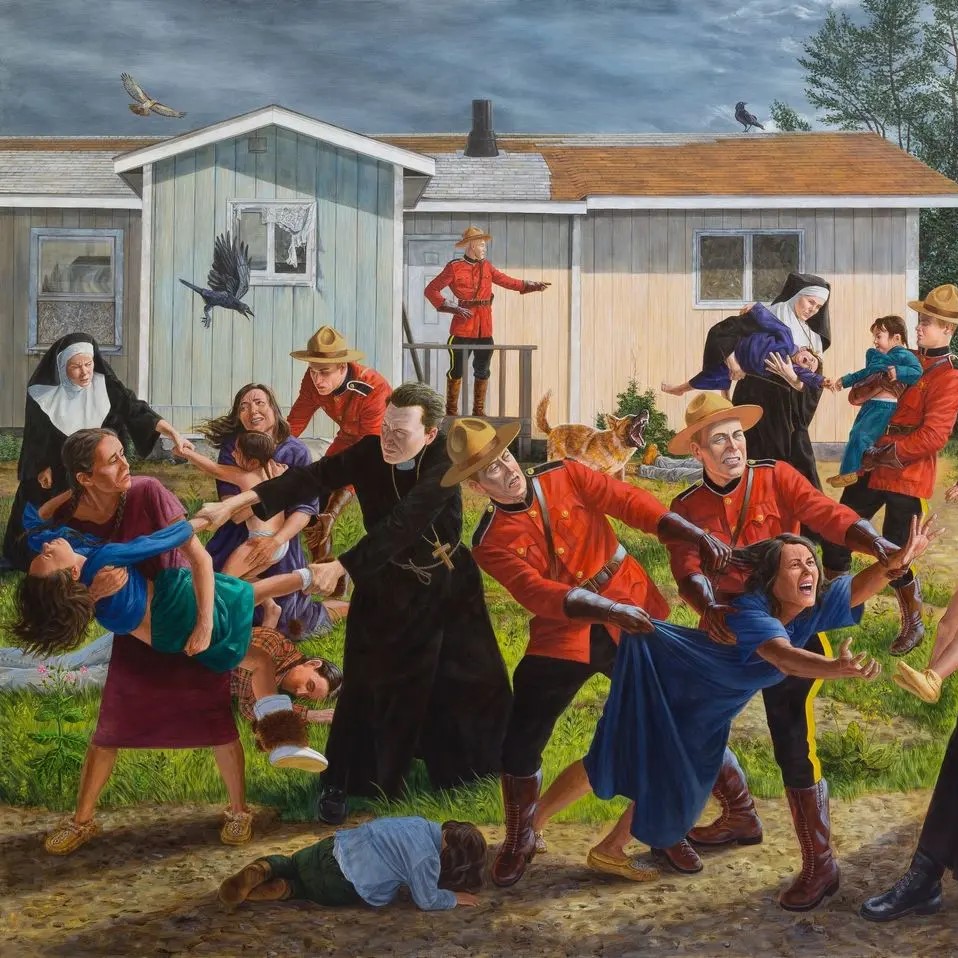
With arms crossed, a Métis curator contemplates Kent Monkman’s The Scream (2017) at the Winnipeg Art Gallery. The history painting dramatizes Canada’s seizure of First Nations, Inuit and Métis children for incarceration and assimilation in church-run Indian Residential Schools. The tragedy roils in a sunlit yard between a modest rural house and the viewer. Two black-cassocked priests, a pair of wimpled nuns and seven men in scarlet tunics swarm a reserve to separate 10 children from their families, homes, language, spirituality, culture and dignity.

History is edited by the Victors: Rethinking Indigenous Public Art

History is edited by the Victors: Rethinking Indigenous Public Art

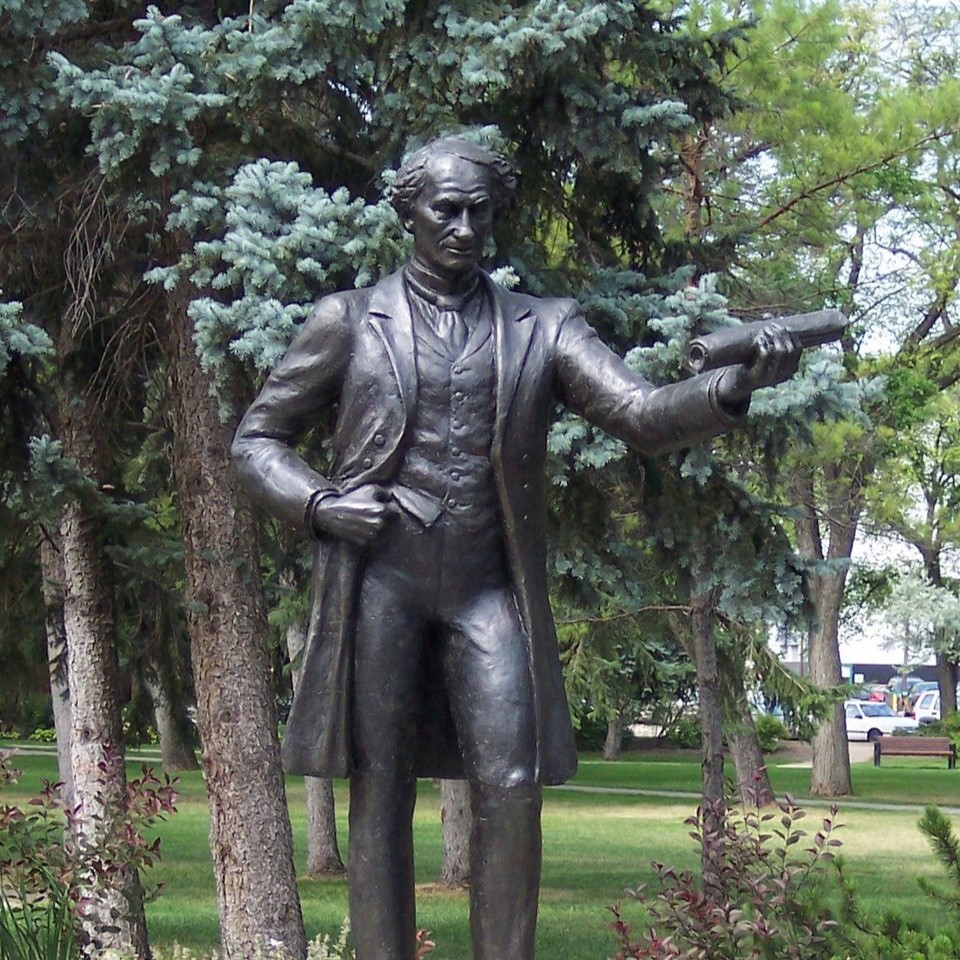
The John A. Macdonald statue in Victoria Park, Regina, is an ordinary oddity. Its strangeness is easy to ignore if you identify with the man represented and the people who commissioned, made, and paid for it. To Indigenous folks, the sculpture is a routine provocation. Like the equestrian Queen in front of the Legislative Building, the statue is a proclamation of colonial power to a provincial outpost, a reminder of who was and is in charge.